
Axe vs Tomahawk: Why the Difference Matters
At first glance, an axe and a tomahawk can appear to be almost the same thing: a sharpened metal head fixed to a wooden handle. Yet that simple resemblance hides centuries of different traditions, purposes, and craftsmanship.
The confusion is understandable. Both belong to the wider family of edged tools, and both have been used as practical implements as well as weapons. But axe vs tomahawk is not simply a comparison between two names for the same object.
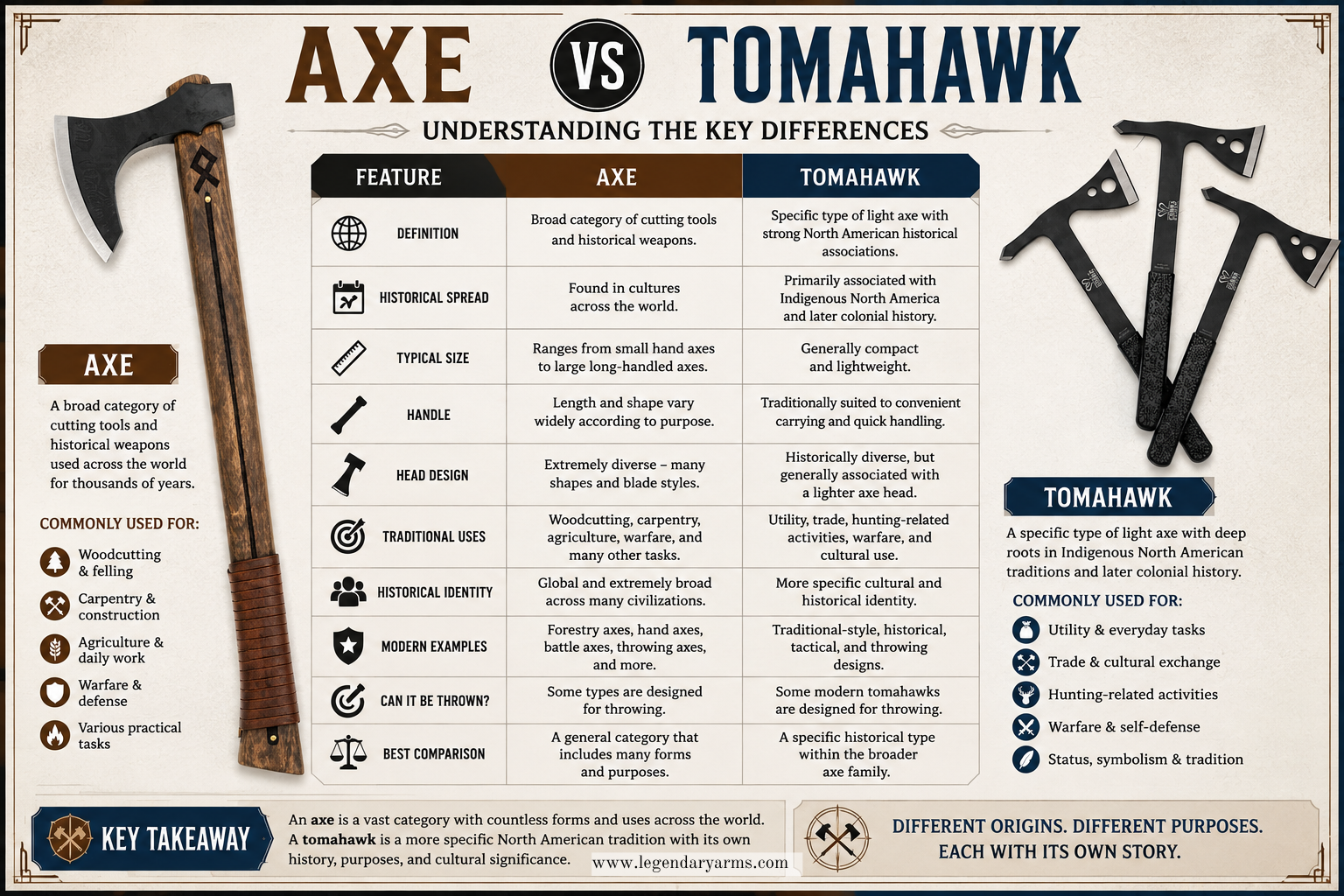
An axe is a broad category that includes everything from heavy felling axes to compact hand axes and historical battle axes. A tomahawk, on the other hand, refers to a more specific type of light axe associated particularly with the Indigenous peoples of North America and the colonial-era trade networks that followed.
Understanding that distinction makes it easier to appreciate why these objects look the way they do.
What Is an Axe?
The axe is one of the oldest and most widespread cutting tools in human history.
Its basic design is remarkably simple: a cutting edge mounted on a haft, allowing the user to concentrate force along the blade. From that foundation, different cultures developed countless variations according to the work at hand.
A forestry axe needed to cut timber. A splitting axe was shaped around processing wood. A carpenter's axe required control and precision. Historical fighting axes could be designed with thinner blades, extended cutting edges, or distinctive profiles suited to combat.
That is why the word axe tells us surprisingly little about a particular object until we know its intended purpose and historical period.
A Viking axe, for example, is not simply a smaller version of a modern woodcutting axe. Historical examples varied considerably in size and form, with some featuring broad blades and pronounced lower extensions known as beards.
What Is a Tomahawk?
The tomahawk has a much more specific historical identity.
The English word tomahawk is derived from an Algonquian term and became associated with light axes used by Indigenous peoples of North America. Historical tomahawks were not produced according to one universal pattern. Their forms changed over time and varied according to region, materials, makers, and cultural exchange.
During the colonial period, European traders introduced manufactured axe heads into Indigenous trade networks. These objects were sometimes adapted, decorated, or hafted according to local traditions.
Tomahawks therefore occupied more than one role. They could serve as practical implements, trade objects, status symbols, and weapons. Their relatively compact size also made them convenient to carry.
This history is essential when discussing the difference between an axe and a tomahawk. A tomahawk is not merely an axe with a shorter handle. Its name carries a particular North American historical and cultural context.
Axe vs Tomahawk: The Main Differences
Is a Tomahawk an Axe?
Yes, in the broadest sense, a tomahawk can be considered a type of axe.
But the reverse is not true. An axe is not automatically a tomahawk.
It is similar to the relationship between a sword and a particular sword type. “Sword” describes a broad family, while terms such as longsword, arming sword, or sabre identify more specific forms.
The same principle helps explain the tomahawk vs axe distinction.
Hatchet vs Axe vs Tomahawk
The comparison becomes more interesting when a hatchet enters the discussion.
A hatchet is generally a small axe intended for tasks such as light chopping, cutting branches, and campsite work. Because of its size, it can resemble a tomahawk more closely than a full-size forestry axe does.
However, size alone does not determine whether something is a tomahawk.
Historical origin, head construction, intended purpose, and cultural context all matter. That is why hatchet vs axe vs tomahawk is better understood as a comparison of related categories rather than three interchangeable names.
Viking Axe vs Tomahawk: Are They Related?
The answer is no in terms of historical origin.
Viking axes belong to the Scandinavian world of the Viking Age, roughly the late eighth through 11th centuries. Tomahawks developed within the Indigenous cultures of North America and have a much later historical context.
Their resemblance comes from a shared basic principle rather than direct influence.
Both demonstrate how humans repeatedly arrived at similar solutions to practical problems: attach a cutting edge to a haft, balance it for controlled use, and adapt the design to the environment and task.
For enthusiasts interested in historical replicas, this distinction is particularly important. A Viking axe and a tomahawk may both belong in a collection of historical arms, but they represent entirely different cultures and periods.
Throwing Axe vs Tomahawk
Modern throwing has added another layer to the comparison.
There are axes and tomahawks specifically designed for throwing, with balance, handle dimensions, and head geometry adapted to that activity. However, a historical axe or tomahawk should not automatically be classified as a throwing weapon simply because it can be thrown.
Modern sporting designs are often optimized for predictable rotation and target penetration, while historical examples were created for the needs of their own time.
For collectors and reenactors, that distinction helps separate historical interpretation from modern recreation.
Which Is Better: An Axe or a Tomahawk?
There is no universal winner because the two terms describe objects with different design traditions.
A full-size axe is generally better suited to demanding chopping work when compared with a compact tomahawk. A tomahawk, meanwhile, offers the portability and handling characteristics associated with a much smaller axe.
For a collector, the more useful question may be: Which historical tradition does the piece represent?
That question shifts the focus from size and cutting power to craftsmanship, authenticity, materials, and historical context.
Final Thoughts
The real answer to axe vs tomahawk lies in understanding that they are not simply competing tools.
The axe is a vast category that has evolved across civilizations for thousands of years. The tomahawk represents a more specific North American tradition shaped by Indigenous craftsmanship, trade, cultural exchange, and later historical interpretation.
Once that distinction is understood, the differences become much clearer.
For collectors, reenactors, costumers, and history enthusiasts, that context adds another layer of meaning to a historical axe or tomahawk. The shape of the head, the length of the haft, and even the way an object was carried can tell us something about the people who made and used it.
That is what makes historical arms so fascinating. The object is only half the story. The other half is the history behind it.