
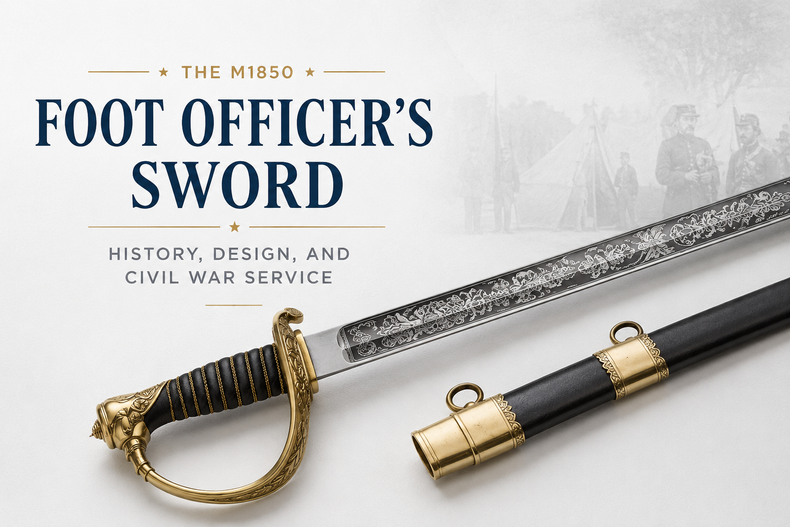
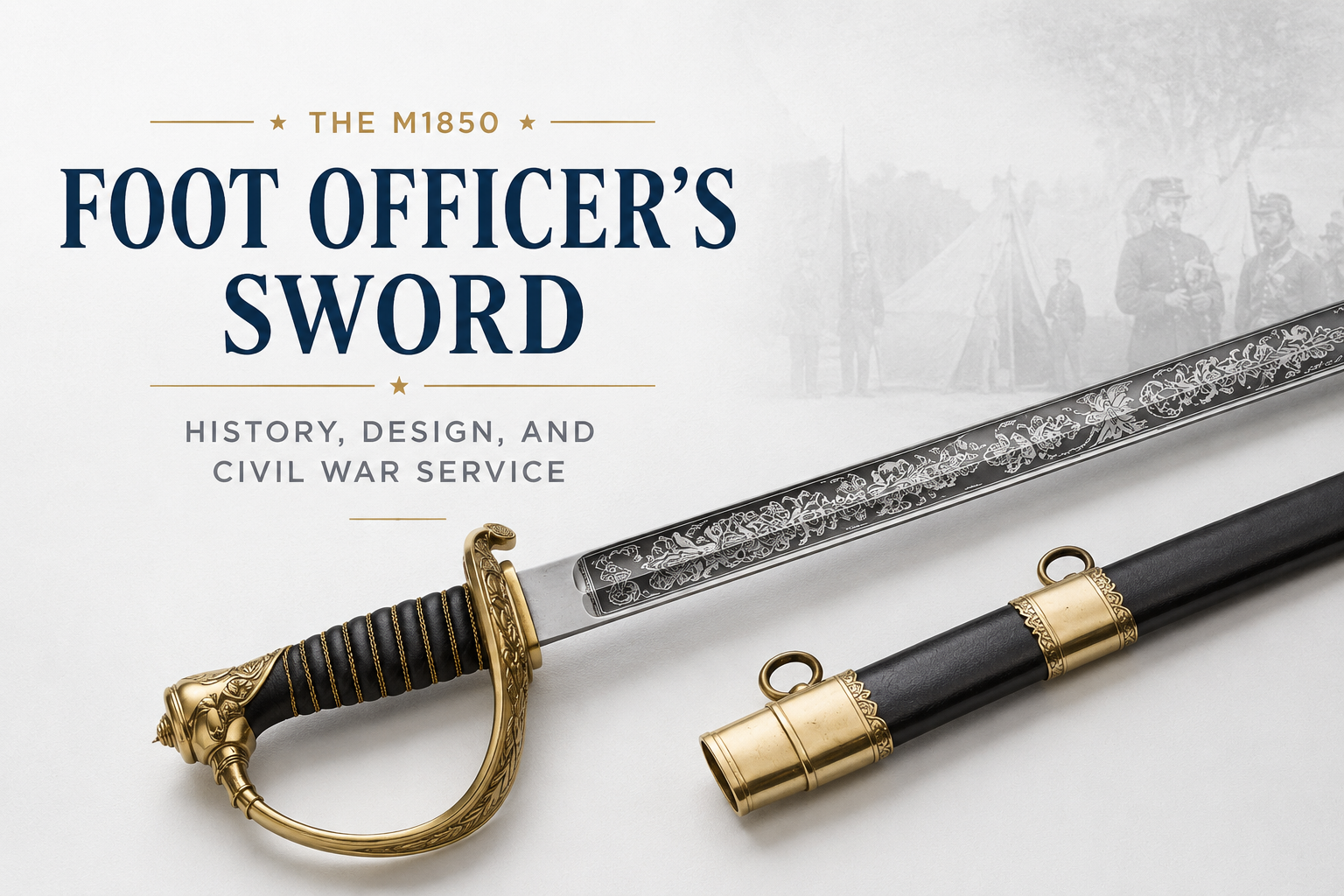
The M1850 Foot Officer's Sword: History, Design, and Civil War Service
Among collectors and historians of Civil War militaria, few sword patterns are as widely recognized as the Model 1850 Foot Officer's Sword. It appears repeatedly in period photographs, museum collections, and auction records, and for good reason: it was one of the defining sidearms of the American officer corps during the mid-19th century.
The M1850 was never intended purely as a weapon. In the 1850s and 1860s, an officer's sword functioned as much as a component of his uniform and rank as it did a practical instrument, worn daily as a visible marker of authority and professional standing. Unlike the curved cavalry sabers issued to mounted officers, the M1850 was designed specifically for officers who served and fought on foot alongside their troops.
This article examines the sword's origins, its design and construction, the officers who carried it, its role during the Civil War, and how collectors identify authentic examples today.
What Is the M1850 Foot Officer's Sword?
The designation M1850 refers to the year the U.S. military adopted this sword pattern under its 1850 regulations. Foot officer identifies its intended user: an officer serving in infantry or other non-mounted units, as distinct from cavalry officers, who were issued a different pattern altogether.
What Does Foot Officer Mean?
The term foot designates an officer who marched and fought on the ground rather than on horseback. This distinction directly shaped the sword's proportions and balance, which were designed for a man moving on foot rather than mounted combat.
The Origins of the M1850 Pattern
American military sword design in the early 19th century drew heavily on European models, particularly French and British traditions, as the U.S. Army worked to modernize and standardize its equipment. Prior to 1850, officer swords varied considerably by rank, branch, and individual procurement, a lack of consistency that did little to support the Army's efforts toward professionalization.
Why Was the M1850 Pattern Introduced?
The 1850 regulations were established to address this inconsistency. The Army sought a sword that clearly reflected rank and branch, could be manufactured to a uniform standard, and remained functionally practical rather than purely decorative. The pattern was adopted a full decade before the Civil War began, meaning it was already a well-established piece of officer equipment by the time the conflict started, rather than a wartime innovation.
The M1850 During the Civil War
By 1861, the M1850 was firmly established as standard equipment for Union infantry officers. On the battlefield, it served a genuine tactical function: a raised sword could signal an advance or steady a wavering line, a form of visual communication that carried real weight before the era of modern signaling. Off the battlefield, it played an equally important role in reviews, ceremonies, and the formal portraits many officers had taken before departing for the front.
It is worth noting that equipment was not perfectly uniform across the Union Army. Supply constraints, personal purchase, and regimental variation all contributed to some diversity even within a regulated pattern. Nonetheless, the M1850 remained the predominant foot officer's sword throughout the war and is closely associated with Union infantry leadership of the period.
Who Carried the M1850 Foot Officer's Sword?
The M1850 was carried by foot officers: company-grade officers such as lieutenants and captains commanding infantry units, along with other non-mounted officers subject to the same regulations. This distinguished it clearly from the weapons of enlisted soldiers, who were issued muskets and bayonets rather than dress sidearms, and from the sabers of mounted officers, who followed a separate cavalry pattern.
Design and Construction
The Blade was slender and moderately curved, built for handling and presentation rather than sustained heavy combat, reflecting the sword's dual role as weapon and symbol of rank.
The Guard provided a measure of hand protection while incorporating decorative elements, often floral or patriotic in design, that reinforced its ceremonial character.
The Grip and Pommel was typically wrapped for a secure hold, with a pommel shaped to balance the blade and add visual presence to the overall design.
The Scabbard The scabbard, constructed of leather or metal, housed the blade and attached to the officer's belt, integrating the sword into the broader uniform system.
What Distinguished the M1850
Compared to a cavalry saber, the M1850 was lighter and more refined, built for a man on foot rather than for mounted combat. Compared to enlisted weapons, it functioned clearly as a symbol of rank rather than a purely utilitarian tool. And compared to later, purely ceremonial swords, it retained genuine practical use. This combination of qualities gives the M1850 a distinct place within the broader history of American military sword patterns.
M1850 Foot Officer's Sword vs. M1860 Staff & Field Officer's Sword
|
Feature |
||
|---|---|---|
|
Pattern |
1850 |
1860 |
|
Intended Users |
Foot/infantry officers |
Staff and field officers |
|
Era |
Pre-Civil War through Civil War |
Civil War era |
|
Primary Role |
Officer sidearm |
Officer sidearm |
|
Design |
Lighter, built for infantry use |
Built for higher-ranking staff roles |
How to Identify an M1850 Foot Officer's Sword
Collectors typically evaluate several characteristics in combination rather than relying on a single feature. Key points of examination include the blade shape and etching, guard design, grip wrap and pommel style, scabbard construction, and any manufacturer or unit markings present. Because genuine wartime examples vary in condition and detail, identification is best approached holistically rather than through any one defining trait.
A Symbol of Rank and Authority
Beyond its practical function, the M1850 represented something larger: the professional identity of the 19th-century American officer. It signified rank, discipline, and military tradition, connecting its wearer to a long lineage of officer service that extended well beyond any single engagement.
The M1850 for Collectors and Reenactors Today
Modern interest in the M1850 spans several areas, including Civil War reenactment, museum interpretation, historical research, and private collecting. For those drawn to this history, historically inspired reproductions, such as the Legendary Arms M1850 Foot Officer's Sword, offer a way to engage directly with this legacy.
Conclusion
The M1850 Foot Officer's Sword represented far more than a blade. It reflects the development of American military equipment, the role of the commissioned officer, and the visual language of authority during one of the most defining periods in the nation's history. Whether encountered in a museum display or carried by a reenactor today, it remains a tangible connection to that era, and one that continues to merit closer study.