
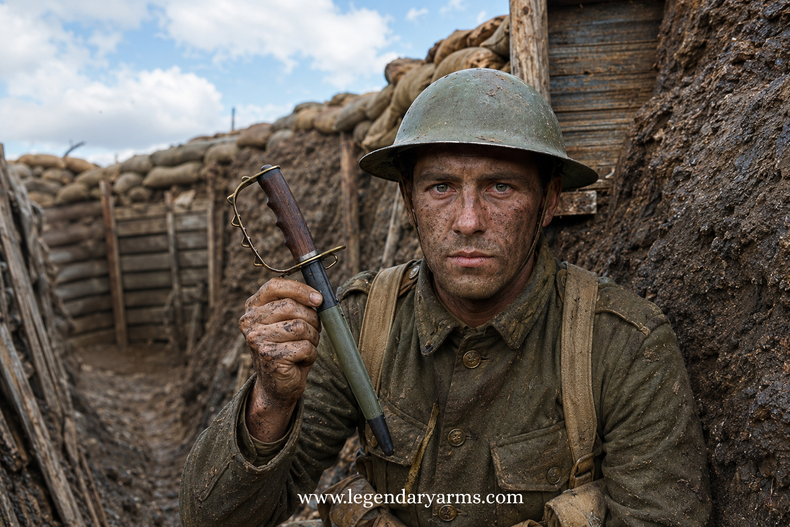
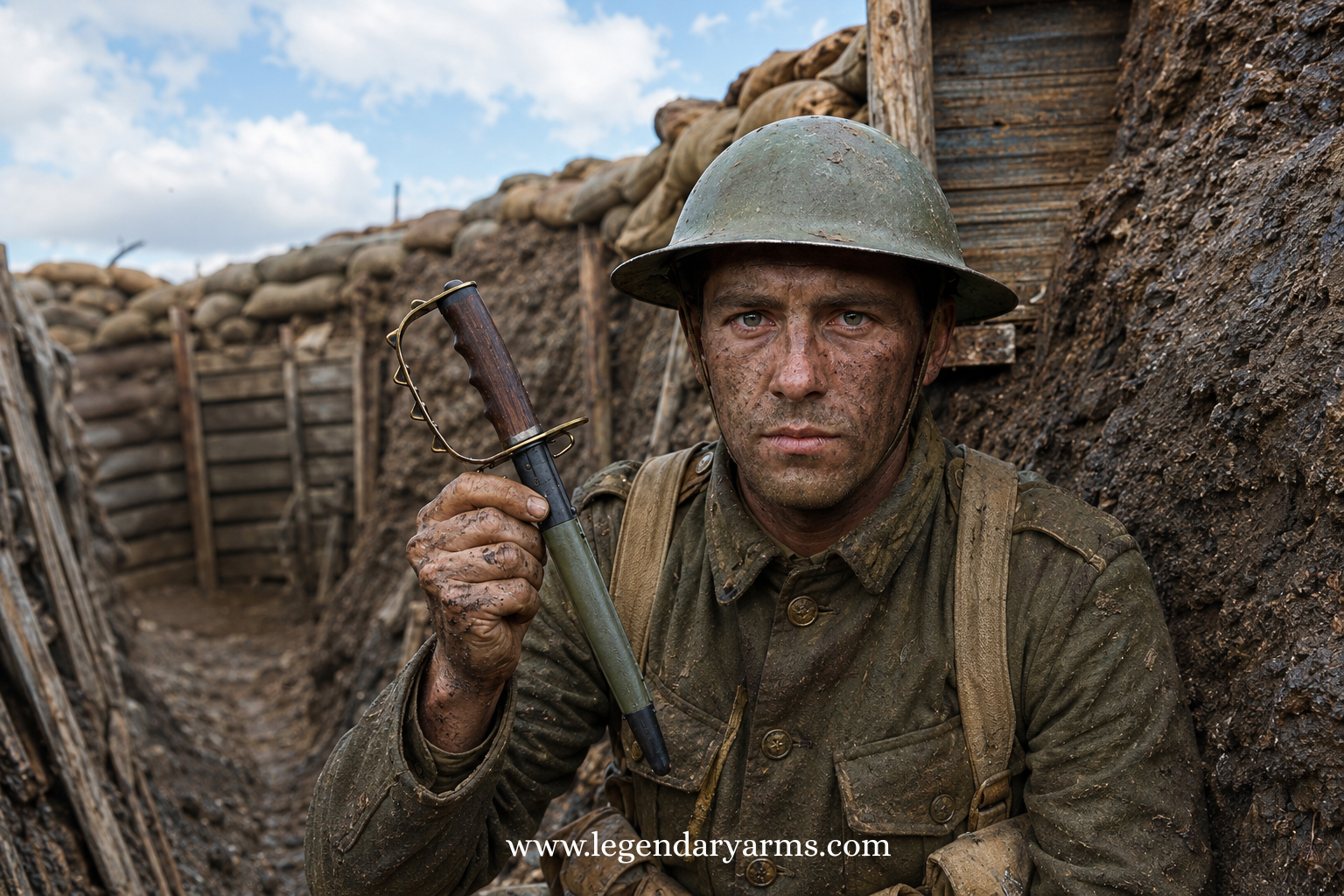
When people picture World War I, they think of muddy trenches, barbed wire, and the relentless boom of artillery. What they rarely picture is a soldier, inches from the enemy, reaching for a knife. But that is exactly what happened — thousands of times — in the narrow, suffocating corridors of the Western Front. The U.S. trench knife was born out of that brutal necessity. It was not a ceremonial piece or a side thought. It was a purpose-built solution to one of the war's most urgent problems: how do you fight when there is no room to swing a rifle? This is the story of how that knife was made, why soldiers trusted it, and why it still matters today.
The Challenges of Trench Warfare During World War I
Trenches ran for hundreds of miles across Europe. They were narrow by design — wide enough for one man to pass, deep enough to crouch in. That environment turned conventional military thinking on its head.
Why Traditional Weapons Were Not Always Effective
A standard-issue rifle in WWI measured around four and a half feet long with a bayonet attached. In open field combat, that length gave soldiers reach and stopping power. Inside a trench, it became a liability. You could not swing it, aim it, or reload it fast enough when someone was right in front of you. Pistols helped, but ammunition was limited and misfires were common in damp, muddy conditions.
The Rise of Close-Quarters Combat
Nighttime raids were common. Small groups of soldiers would slip into enemy trenches to gather intelligence, take prisoners, or neutralize positions silently. These missions demanded weapons that were quiet, compact, and lethal at arm's reach. Hand-to-hand fighting was not a last resort — it was a planned part of WWI close combat strategy. Soldiers needed tools built specifically for that kind of violence.
The Origins of the U.S. Trench Knife
The Americans did not reinvent the wheel. When the United States entered the war in 1917, Allied forces — particularly the British and French — had already spent years developing close-combat solutions. The British had the Fairbairn-Sykes-influenced fighting knives. The French had their own versions. The U.S. military studied what worked and what did not before designing their own answer.
Lessons Learned from European Battlefields
British and French soldiers had made do with repurposed tools — sharpened entrenching spades, improvised blades, even rocks. What the Americans observed was that a dedicated fighting knife with a sturdy grip and a double-edged blade outperformed everything else in close quarters. The lessons were clear: keep it short, make it grip well, and give it hitting power even when not cutting.
The U.S. Army's Need for a Specialized Fighting Knife
The U.S. Army needed something that could be manufactured at scale, issued to soldiers quickly, and trusted under the worst possible conditions. The answer became the Mark I trench knife — a design that combined European fighting knife principles with distinctly American engineering.
The Mark I Trench Knife: A Revolutionary Design
The Mark I was not just a knife. It was a multi-function close-combat tool, and every part of its design had a specific reason for being there.
Double-Edged Blade for Maximum Effectiveness
The blade was double-edged and tapered to a point — designed to penetrate heavy wool uniforms and equipment with minimal resistance. Unlike a single-edged hunting knife, both edges were sharp, which meant the weapon worked on both the push and the pull stroke. In a close struggle, that versatility could be the difference between surviving and not.
Brass Knuckle Handle for Dual-Purpose Combat
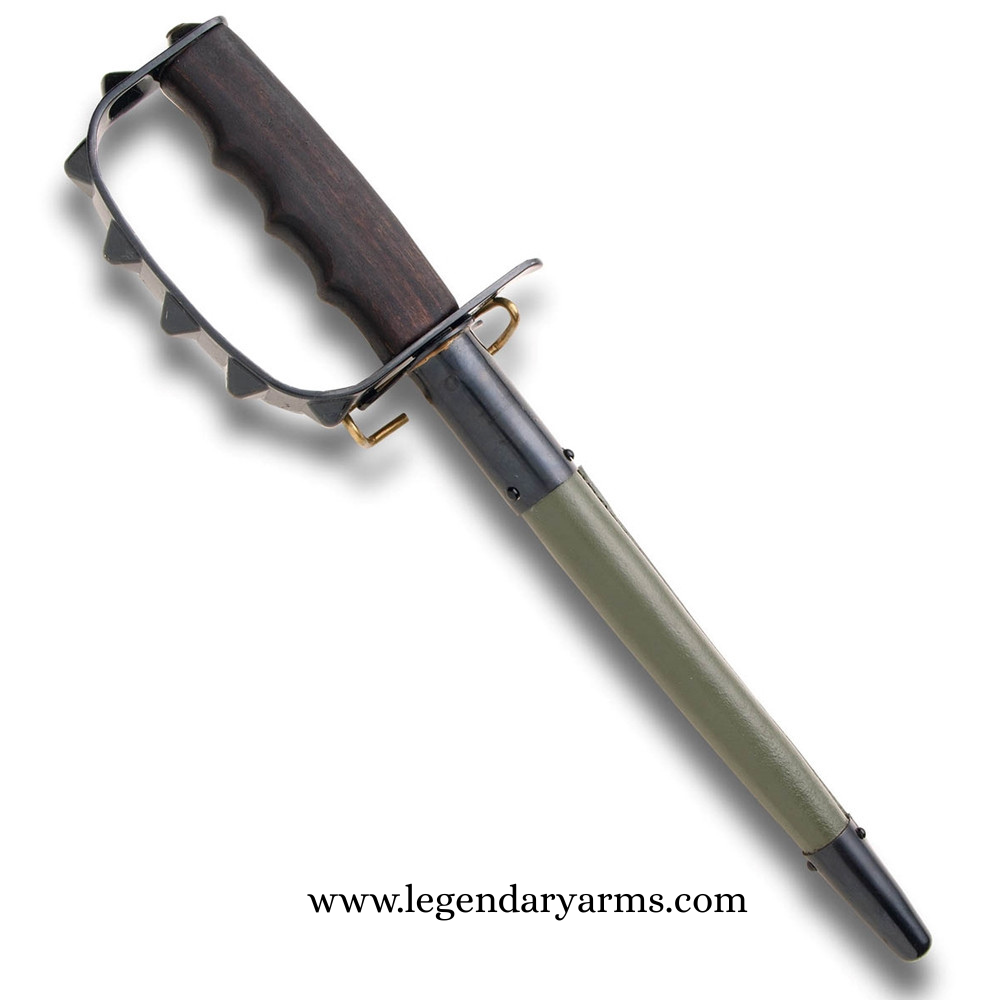
The handle of the Mark I is what made it immediately recognizable. Cast from metal with four finger loops, it functioned as a brass knuckle grip. A soldier could slash with the blade or flip the knife in hand and punch with the handle — delivering a heavy metal strike to an opponent's face or jaw. This made the knife effective even when stabbing was not possible. It also protected the hand during impact, reducing the chance of broken fingers in a scuffle.
Skull-Crusher Pommel Design
At the base of the handle sat a triangular, spiked metal pommel. Soldiers called it the skull-crusher, and the name required no explanation. It added a third mode of attack — a downward strike that could incapacitate an opponent quickly and quietly. The pommel turned the knife into a complete package: blade, punch, and impact weapon in one compact design.
Why Soldiers Trusted the U.S. Trench Knife in Combat
A weapon is only as good as the soldier's confidence in it. The Mark I earned that confidence.
Built for Survival in the Trenches
The knife was compact enough to carry on a belt without getting in the way during long marches. The metal construction meant it did not warp or swell in the rain-soaked trenches the way wood-handled tools often did. It was simple to clean and did not require maintenance that soldiers rarely had time for.
A Weapon Designed for Close-Range Encounters
Soldiers used it during nighttime raids when silence mattered more than speed. They used it when their rifles jammed. They used it when ammunition ran out. The psychological impact was real too — carrying a weapon purpose-built for the worst-case scenario gave soldiers a quiet kind of confidence. Opponents who encountered the brass knuckle knife knew they were facing something designed with lethal intent from grip to tip.
How the Trench Knife Became a Symbol of American Military History
The American Expeditionary Forces (AEF) arrived in Europe in 1917 under General Pershing. The soldiers who carried the Mark I brought with them an image of American military competence and resolve. The trench knife became part of that identity.
Beyond the Battlefield
Stories of the knife's effectiveness spread through military dispatches and letters home. By the time the war ended in 1918, the Mark I had earned a reputation far larger than its physical size. It appeared in military journals, training materials, and newspapers as a symbol of the AEF's fighting spirit.
A Lasting Symbol of WWI Combat
Unlike many weapons that faded into obscurity after the war, the trench knife remained present in military memory. It represented a specific kind of soldier — resourceful, adaptable, willing to fight at the closest possible range. That image never really left.
The Trench Knife's Legacy Among Collectors Today
Nearly a century after the last shot was fired on the Western Front, demand for original WWI trench knives remains strong and continues to grow.
Why Collectors Value Original Trench Knives
An authentic Mark I trench knife is not just a piece of metal. It is a direct physical link to one of history's most significant conflicts. Collectors who find examples with original scabbards, intact markings, and period-correct finishes understand they are holding something that a real soldier carried into real combat. That connection carries weight that no reproduction can replicate. Original examples in good condition are increasingly rare, which pushes value steadily upward.
Preserving a Piece of Military History
Responsible collectors store, document, and sometimes display their pieces in ways that keep the history alive. Museums, private collections, and military heritage organizations all play a role in ensuring these artifacts survive. Reproductions serve their own purpose — they allow enthusiasts to handle the design, understand the ergonomics, and appreciate the engineering without risking damage to original pieces. But for serious collectors, there is no substitute for the real thing.
What Makes the U.S. Trench Knife Iconic Even Today?
Few weapons from any era carry the combination the Mark I offers: a singular design story, proven battlefield effectiveness, deep historical roots, and growing collector appeal. The WWI trench knife was not born in a design studio. It was born in the mud, under fire, shaped by what soldiers actually needed when everything else failed. That origin story is hard to replicate — and impossible to forget.
Final Thoughts
The U.S. trench knife was never just a weapon. It was a solution — forged at the intersection of desperation and ingenuity, shaped by the brutal feedback loop of actual combat. It adapted to the conditions of the World War I battlefield in ways that longer, slower, or simpler weapons simply could not. For the soldiers who carried it, it was a last line. For history, it became a landmark. And for collectors today, it remains one of the most compelling pieces of American military heritage you can hold in your hands.
If you're serious about military collectibles or historical firearms, exploring authenticated pieces like the Mark I connects you directly to the stories that shaped modern history. At Legendary Arms, we specialize in exactly that kind of connection — between serious collectors and the artifacts that deserve to be preserved.