
Exploring the World of Royal Armouries Swords
A medieval sword was never simply a blade carried into battle. Look closely at one and you begin to see the world that shaped it. The length of the blade, the shape of the guard, the size of the grip, and even the way the sword was held all reflect the needs and ideas of its time.
That is what makes medieval swords so interesting. They changed as armor became more sophisticated, fighting methods evolved, and swordsmiths experimented with different forms. The result was not one standard medieval sword, but a fascinating range of designs.
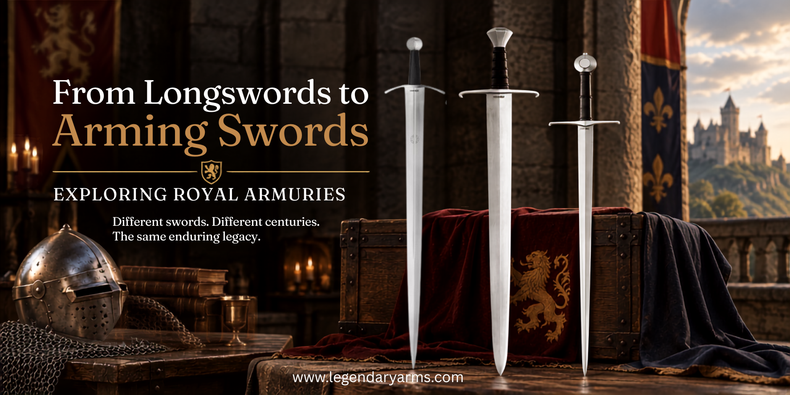
The Royal Armouries collection brings several of these forms together. The 14th Century Longsword, 15th Century Longsword, European 14th Century Arming Sword, and Single-Edged Arming Sword each offer a different look at medieval sword traditions.
So, what separates one from another? And what can these differences tell us about the people who carried them?
How Medieval Swords Changed Over Time
It is tempting to think of medieval sword history as a straight line, with one design replacing another. The reality was much more interesting.
Different sword types existed side by side, often serving different purposes. A one-handed sword could be a practical companion to a shield, while a longer sword offered different possibilities for two-handed fighting. Regional traditions also played a role, meaning that sword design could vary considerably across medieval Europe.
Armor was another major influence. As protection improved, particularly with the growing use of plate armor, swords and swordsmanship had to adapt. Blades became increasingly varied in their shapes and proportions, while fighting techniques became more sophisticated.
This is why a 14th century longsword should not simply be viewed as an older version of a 15th century longsword. Both belong to the same broad tradition, but each reflects a particular stage in its development.
The 14th Century Longsword: A Sword with Reach and Versatility
The Royal Armouries 14th Century Longsword represents an early chapter in the story of the European longsword.
One of the first things that stands out is its longer proportions. Compared with the compact arming swords associated with one-handed use, a longsword offers a noticeably longer grip and blade. That extra grip provides room for both hands, giving the sword a very different character in the hand.
The longsword's appeal also comes from its versatility. It was not limited to one particular style of fighting. Its design could accommodate different techniques and ways of handling the blade, which helps explain why the longsword became such an important part of later medieval martial traditions.
For a collector, this sword is interesting precisely because it captures a period of transition and experimentation. It has the unmistakable presence of a longsword, while retaining the proportions and character associated with the 14th century.
It is a reminder that medieval swordsmanship was already far more sophisticated than the familiar image of knights simply swinging swords at one another.
The 15th Century Longsword: Where the Tradition Goes Next
Move forward another century and the longsword becomes an even more fascinating subject.
The Royal Armouries 15th Century Longsword represents a later point in the tradition, when swordsmanship and armor had continued to evolve. By this time, longswords had become firmly established within European martial culture, and their designs could be adapted to increasingly demanding fighting techniques.
The differences between 14th and 15th century examples are not always dramatic at a glance. That is part of the fun of studying them. Small changes in proportions, blade geometry, and handling can reveal how sword design was responding to the world around it.
14th Century vs. 15th Century Longsword
| Feature | 14th Century Longsword | 15th Century Longsword |
| Period | Earlier medieval longsword tradition | Later medieval tradition |
| Grip | Extended for versatile handling | Extended for longsword techniques |
| Character | Earlier form of the longsword | More developed later form |
| Historical interest | Shows the emergence of the longsword | Shows its continued refinement |
Rather than asking which one is "better," it makes more sense to see them as two snapshots from the same fascinating story.
European 14th Century Arming Sword: The Classic Knight's Sword
Then there is the European 14th Century Arming Sword, a very different kind of medieval blade.
Where a longsword is associated with a longer grip and the option of using both hands, an arming sword is designed primarily for one-handed use. That made it particularly well suited to being carried alongside a shield.
This is the sword that often comes to mind when we picture a medieval knight: a relatively compact, double-edged blade, a crossguard, and a grip sized for one hand. Its proportions give it a balanced and unmistakably medieval appearance.
The arming sword was more than a visual symbol of knighthood, though. Its practicality helped make this form an important part of medieval sword traditions.
For anyone interested in medieval history, the contrast between an arming sword and a longsword is especially useful. It shows just how misleading the phrase "medieval sword" can be. There was no single shape that represented every warrior, period, or fighting style.
Single-Edged Arming Sword: A Different Side of Medieval Sword Design
The Royal Armouries Single-Edged Arming Sword takes the story in another direction.
Unlike the familiar double-edged arming sword, this type of blade has a single cutting edge. That one difference gives it a noticeably different appearance and makes it an intriguing addition to a collection of medieval sword forms.
Single-edged swords are particularly interesting because they remind us that medieval sword traditions were not limited to the shapes most commonly seen in films and popular culture.
For collectors, this kind of sword can offer something different. Instead of choosing another familiar double-edged blade, a single-edged arming sword provides an opportunity to explore a less conventional side of medieval weapon design.
Four Swords, Four Ways of Looking at the Middle Ages
Put these four swords next to each other and the variety becomes clear.
The 14th Century Longsword represents an earlier form of the longsword tradition. The 15th Century Longsword shows how that tradition continued to mature. The European 14th Century Arming Sword brings us back to the classic one-handed knightly blade, while the Single-Edged Arming Sword demonstrates that medieval sword design had plenty of room for variation.
| Sword | What Makes It Interesting |
| 14th Century Longsword | An early and versatile longsword form |
| 15th Century Longsword | A later stage in longsword development |
| European 14th Century Arming Sword | Classic one-handed knightly sword |
| Single-Edged Arming Sword | Distinctive alternative to the double-edged blade |
Seen together, they are less like four unrelated products and more like four pieces of a much larger historical picture.
What Makes a Good Medieval Sword Replica?
Once you start looking beyond appearance, choosing a medieval sword replica becomes much more interesting.
Start with the history. Does the sword represent a particular period or tradition? Then look at the details: blade proportions, guard, grip, materials, construction, and finish.
It is also worth considering how you plan to use it. A sword intended primarily for display or collecting has different requirements from one designed for reenactment or supervised historical training.
The best replica is not necessarily the most elaborate one. It is the one whose design, construction, and purpose make sense for what you are looking for.
Why Royal Armouries Swords Still Capture Attention
There is something satisfying about holding a sword that has been inspired by a design from centuries ago. For collectors, it can become a tangible piece of history. For reenactors and costume enthusiasts, it can add authenticity to a historical impression. For HEMA practitioners and students of martial history, the shape of the sword can provide another way to understand the techniques associated with it.
That broad appeal is what keeps historical swords relevant today. They combine craftsmanship with a story, and the more you learn about the sword, the more that story begins to take shape.
The Royal Armouries range offers several different starting points, depending on which part of medieval sword history interests you most.
Final Thought: More Than a Replica
The most interesting thing about a historical sword is often what you cannot see immediately.
A longer grip hints at a different method of handling. A particular blade shape reflects changing ideas about combat. A single edge sets one sword apart from another tradition. Even small details can tell us something about the period that produced them.
That is why comparing the Royal Armouries longswords and arming swords is so worthwhile. They are not simply different shapes of steel. Each represents a different chapter in the long history of medieval swordmaking.
The real appeal of a historical sword lies not only in how it looks, but in the history and craftsmanship that its design represents.